
 English
 中文简体
中文简体 русский
 Español
 Deutsch


Mechanical Response Latency and Tripping Velocity Analysis of Elevator Safety Systems
Content
Centrifugal Force Mechanics and Tripping Speed Calibration
1. The operational reliability of an overspeed governor in elevator depends on the precise calibration of centrifugal flyweights, which must trigger the safety loop before the car exceeds 115 percent of its rated velocity. 2. In analyzing how centrifugal force design affects overspeed governor consistency, engineers focus on the spring rate (k) of the tensioning mechanism, which counteracts the radial force (Fc = m * omega^2 * r) to prevent nuisance tripping caused by hoistway vibrations. 3. The overspeed governor in elevator must maintain a tripping speed tolerance within +/- 2 percent to ensure EN 81-20 compliance, particularly in high-speed traction lifts where acceleration curves are steep. 4. For systems requiring bi-directional overspeed protection for elevators, the governor architecture must include independent flyweight sets or a dual-acting pendulum to detect both ascending car overspeed and uncontrolled downward movement.
Kinetic Energy Transfer and Mechanical Response Latency
1. The maximum mechanical response latency for overspeed governors is the time interval between the car reaching the tripping speed and the final engagement of the safety gear wedges on the guide rails. 2. To avoid catastrophic downward acceleration, the response time of elevator governor electrical switches must not exceed 50 milliseconds, ensuring the traction motor's power is severed before the mechanical jaws lock the governor rope. 3. Calculating pulling force in elevator governor ropes is essential to verify that the friction generated in the governor pulley groove is sufficient to lift the safety gear linkage, which typically requires a tensile force of 300 to 600 Newtons. 4. If the overspeed governor in elevator experiences excessive latency, the car may reach a free-fall state where the kinetic energy exceeds the absorption capacity of the hydraulic buffer safety equipment at the pit bottom.
Groove Geometry and Friction Coefficient Reliability
1. The groove profile of the overspeed governor pulley (V-groove vs. U-groove with undercut) determines the traction coefficient; a hardened V-groove is often preferred for high-rise applications to maximize rope "bite" during emergency deceleration. 2. A critical factor in preventing elevator governor rope slippage is maintaining the Ra surface finish of the pulley groove between 0.8 and 1.6 micrometers, ensuring consistent friction without causing premature wire rope abrasion. 3. Comparing disk vs flyweight overspeed governors, disk-type governors offer a more compact footprint but may have higher sensitivity to thermal expansion, affecting the air gap and tripping accuracy in unconditioned machine rooms. 4. Technical Parameter Matrix for Governor Assemblies:
| System Parameter | Centrifugal Flyweight Type | Internal Pendulum Type |
| Max Rated Speed | Up to 10.0 m/s | Up to 2.5 m/s |
| Tripping Accuracy | +/- 0.05 m/s | +/- 0.10 m/s |
| Rope Diameter Range | 6 mm - 10 mm | 6 mm - 8 mm |
| Material Grade | GG25 Cast Iron / Steel | Nylon / Composite / Steel |
Dynamic Tensioning and Environmental Durability
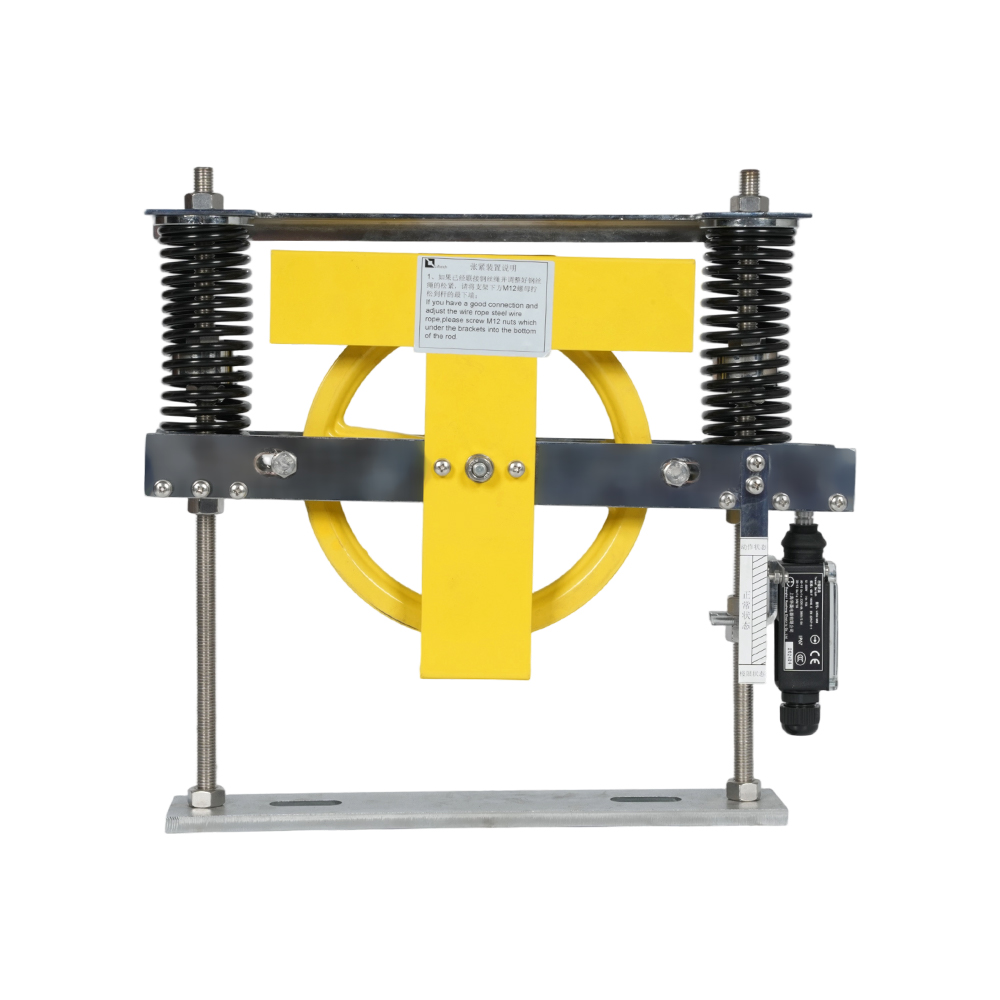
1. The impact of building vibration on overspeed governor tripping is mitigated through the use of anti-vibration dampers in the tensioning pulley assembly, which maintains constant rope tension (typically 200N to 400N). 2. For coastal or high-humidity installations, corrosion resistance in elevator safety governors is achieved through salt-spray tested coatings (ASTM B117) and the use of sealed stainless steel bearings to prevent pivot seizing. 3. Periodic recalibration of elevator governor spring tension is required every 12 to 24 months to account for material fatigue and ensure that the mechanical response latency remains within the safety envelope prescribed by ISO 22201.
Hardcore FAQ
1. What happens if the governor rope breaks during a trip? The system is designed with a tension-weight safety switch. If the rope breaks or loses tension, the electrical safety loop is immediately broken, stopping the lift before an overspeed event can escalate. 2. How does the governor distinguish between a jerky start and actual overspeed? The inertia of the flyweights and the pre-set tension of the calibration spring are calculated to ignore standard acceleration rates (typically 0.5 to 1.5 m/s2) and only react to velocities exceeding the 115% threshold. 3. Can a governor be reset remotely? Electrical switches can often be reset remotely if they are electromagnetic, but the mechanical jaw engagement usually requires a manual reset by a technician at the machine room or overhead to ensure a full safety inspection. 4. Why is the governor rope usually a different construction than hoist ropes? Governor ropes (often 6x19 or 8x19) are optimized for flexibility and friction rather than heavy load-bearing, as they must transition around small pulley diameters without developing fatigue cracks. 5. Does temperature affect the tripping speed? Yes. Extreme cold can increase the viscosity of lubricants and cause metal contraction. Engineering standards require governors to be tested for consistent operation between -10 and +40 degrees Celsius.
Technical References
1. EN 81-20/50: Safety rules for the construction and installation of lifts – Lifts for the transport of persons and goods. 2. ASME A17.1: Safety Code for Elevators and Escalators. 3. ISO 8100-1: Lifts for the transport of persons and goods - Part 1: Passenger and goods passenger lifts.